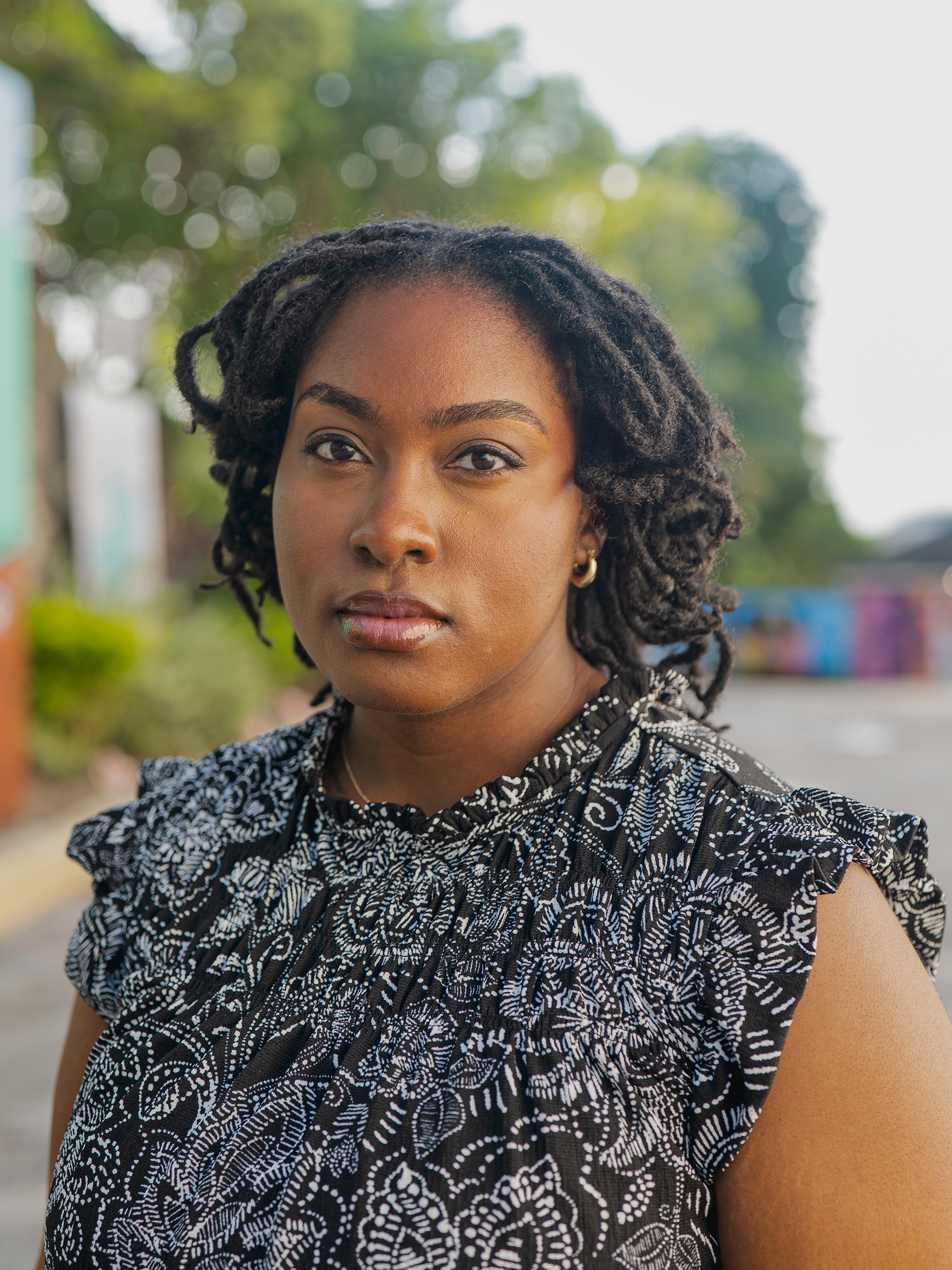
Jodi Minnis-Rolle, the newly appointed Curatorial Director at the National Art Gallery of The Bahamas, speaks with Blake Belcher about the unseen work of curating, NAGB as a breathing organism, and art’s capacity to shape culture. This is the first of a two-part conversation.
Curatorial work often happens behind the scenes. What’s invisible to most people about what you do?
One thing I wish people understood is that it’s very research-heavy, whether that research is academic or happens through observation and relationships. Both merit respect. I think people see the organisation, they see the writing, but they don’t always realise that it can take reading two or three books before you can make one paragraph, or having ten conversations before you can fully relay an artist’s intention to the public.
It looks easy, but it isn’t.
Exactly. It’s a different kind of thinking, too. Your thinking must be subjected to the space you’re curating for. Then you can be expansive about the possibilities of the space—how you might stretch those possibilities, and which limitations you have to stay within.
Once that groundwork is laid, then you can say, “OK, these are the artists who fit within those possibilities and limitations. This is the kind of work that belongs here.” Then you start to merge approach, theme, and concept. It’s slow, but it has to be.
So the space comes first, not the artwork?
Yes. It’s less about the work first and more about the space and audience first. Sometimes it flips, but the way I curate is with respect for the space and its inherent audience. Then I bring artists into the conversation.
You work with emerging artists, historical archives, and contemporary practitioners. How do you think about all of that coming together at NAGB?
What’s special about this institution is the opportunity to present so many facets of our arts ecosystem—to Bahamians and to visitors. When you look at the Project Space and see emerging artists there, you’re allowing people to encounter those artists at a moment where their practices are still forming, where audiences can grow alongside them. It shows that there’s life here, people experimenting, curious, finding their footing—and this is what that looks like.
And those emerging practices, even if they aren’t in direct dialogue with the collection, you can still see through-lines—shared motifs, shared sensibilities—simply because we are of and from this place.
How do you visualise that relationship across the museum?
The Project Space is hugged by the permanent collection galleries. And then above that, you have the temporary exhibition spaces. The Ballroom often lends itself to more experimental, installation-based contemporary work, while the other galleries allow for more historical storytelling.
So there’s this pulse in the middle that says, “We have energy and life in our ecosystem,” grounded by our art historical canon. And above that, there’s the rigour and context that sustains everything. I think of it like a machine—grounded, pulsating, churning, but also breathing life consistently into the community.
That’s where people start to see what’s possible for their own practice. They take risks. They make big work. They make critical work, because they know it can be held by the foundation of the history that exists here.
There’s a lot of conversation around accessibility in museums, and how they can still feel exclusive. How do you balance rigour with approachability?
I don’t think everything can be equally accessible to everyone all the time. What we can do is create multiple entry points so people can engage at whatever level feels right for them. You assess your audience first, and then you leave Easter eggs.
What do you mean by that?
A philosophy I lead with is that a response to an artwork is enough. It means you engaged it. All art asks for is your attention—for you to witness it, to sit with it, to let it ruminate. Whatever that first response is, it’s enough to say you’ve engaged.
I don’t think we give enough value to that. People often feel they have to like art to get it. But you don’t have to like it. We’re not asking you to like it. We’re asking you to engage with it—to form an opinion. And that opinion might be, “This isn’t for me.” And that’s OK.
Even if someone walks away unmoved?
Yes. If you hold space for people not being moved, you hold more space for people who want to go deeper. Those are the people you leave the Easter eggs for. You listen carefully to the artists, you hear all their brilliance, and you create pathways for that audience.
But for someone who says, “I don’t like it”—OK. You came. You saw. You engaged. That’s already something.
At the root of it, engagement is the currency. Period.
You’ve spoken about creating pathways for emotional engagement with art. Where does that come from for you?
Our history as Afro-Caribbean people is deeply utilitarian. A lot of our artistic production was functional. You used the pot. You decorated the walls for a reason. You had zemis in your home because you worshipped them. There wasn’t a distance between you and the work.
Even when something was aesthetic, it often still tied back to a cultural or spiritual practice. So if you’re asking people to observe without creating any kind of emotional or spiritual pathway, then of course it’s going to miss.
The challenge curating in this space is to create opportunities for emotional response—for people to come and worship in their way, or to come and be informed, or to just feel something. It’s not only about cerebral engagement. It’s about that visceral, emotional, sometimes spiritual engagement with the work.
What gets in the way of that?
Language is a big one—how we speak about the work. It’s easy to become heady.
The other is how we curate the space itself. Being intentional about flow. About mood. About how someone moves through the exhibition from beginning to end—while still leaving room for them to engage on their own terms.
What does that look like in practice?
When I curate, I lead with questions: How do I want people to move through the space? What do I want them to feel? What emotion is driving this work? Where do I want them to stop and pause? Where do they need a breather?
I’m deliberate about directing people through the story I’m trying to tell. And at the end, I always leave a site of reflection—then I step back and let the audience decide whether they want to continue that engagement or not.
The pathways are in the intention.
What themes are you most interested in exploring through NAGB’s programming?
I’m very interested in intergenerational conversations—putting older and emerging artists in dialogue and seeing what happens when you allow those relationships to surface.
I’m also interested in taking a more Caribbean art historical approach to some of our writing, and continuing to situate Bahamian art within that broader Caribbean canon.
And then—this is lofty, but it’s something I’ve been thinking about for a while—the West African birth of us. Not influence, but birth. How do we create links between Bahamian art and West African art practices, particularly Nigerian and Ghanaian ones? What kinds of conversations become possible when we’re more intentional about that?
What prompted that line of thinking?
I was speaking with Stan Burnside after an artist talk, and I realised that often there’s such a missed opportunity in reiterating the fact that we are African people. We are African people wielding very European tools while existing within the Caribbean, and also being a part of the Black Atlantic. There’s this multiplicity of histories that keep burgeoning to the surface that I think we don’t consistently bring to the forefront.
There’s a seminal exhibition I didn’t get to see, but the catalogue has stayed with me: What is Africa to Me?, curated by Dr Erica James. That’s been in my brain for quite some time, even before I got this position. What would it be like if every exhibition kind of had that question in it? What is Africa to me?
You’ve also talked about wanting to create links between art production and social values. Can you say more about that?
I’m interested in figuring out how we can take dense research, propositions, and contemporary critical theory and translate that into action—to establish social values? To take it outside the concept realm.
How do you see that happening?
Art is inherently political. There’s nothing apolitical about it. There’s always a soundtrack to a revolution. Revolutions were pushed by printmakers—printmaking is accessible and has been at the forefront of social change. How do we link that history to what happened here in The Bahamas, for example? Art for entertainment’s sake will always exist, but culture is informed by society—and it can also be intentionally created. If we keep relegating culture to entertainment, we miss its power as a tool for value-making and system-making.
Is there a precedent for art as a political or cultural tool in The Bahamas?
Absolutely. Stan Burnside, Antonius Roberts, and the B-CAUSE movement made work that was inherently political and culture-shaping. Whether through painting, Junkanoo, or editorial cartoons, they shaped visual culture here.
Has that changed?
The proximity has changed. Earlier generations of artists were closer to people in government or administrative functions who appreciated and understood the role of art in society.
Where does NAGB fit in that landscape now?
Having a national institution that makes room for very hard conversations—it just makes sense for us to position ourselves to listen, relay the artist’s message, and see how those conversations might influence change. NAGB’s role is to create the space for that dialogue and trust that the right people will engage with it.
Your role also oversees education at NAGB. How does education fit into creating those pathways for engagement?
Education is where those pathways begin, whether it’s through writing, workshops, or creating space for artists to present their research and ideas.
I speak to education often because they are the translators for the museum at large. If we want to raise the standard of our community to meet the level of artistic production, there has to be a space that provides criticality and rigour. Not everybody’s going to go to UB to get a degree in art, but NAGB can be another space where people come and learn.
What does that look like in practice?
I see education serving the whole community, not just students. The summer camp is extremely robust, but I want to add even more support through academic presentations and workshops to diversify offerings and skills.
I also see masterclasses with artists that would appeal to a more established artist base. I want to fortify scholarship through essays, reviews, and publications to really drive home the rigour of the collection.
So, NAGB as a space for lifelong learning?
Exactly. How do we keep our arts professionals informed? How do we develop workshops for working artists? I see the institution as a space where all arts professionals can come to learn—not just about visual art, but business, history, theory, philosophy. That’s how I want to carve that out.
Next week: Minnis-Rolle on her journey to this role, how making art shapes her curatorial practice, and what she envisions for NAGB beyond the galleries.