By Letitia Pratt
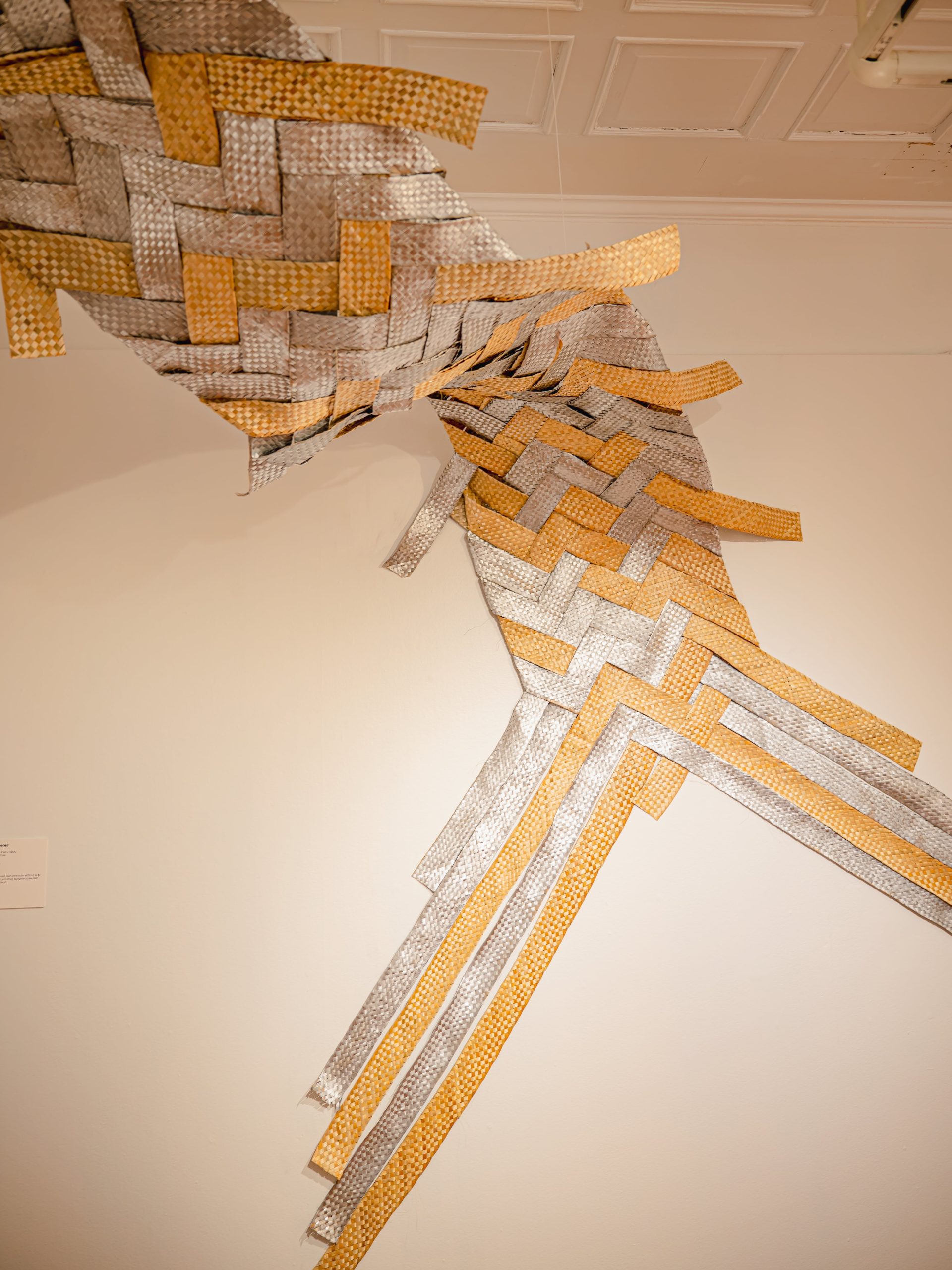
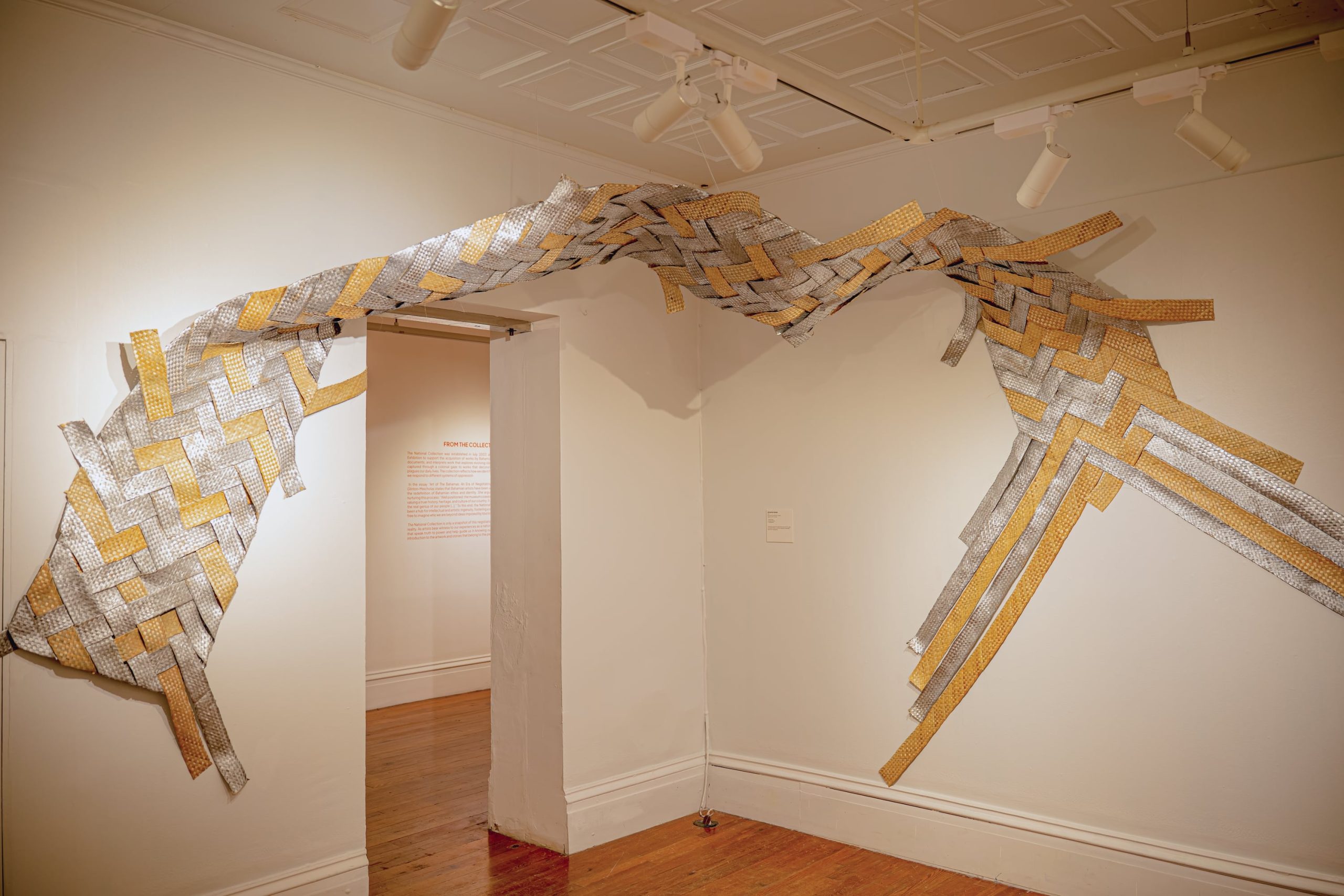
As you walk into the Project Space Gallery on the first floor of the museum, you are accosted by three snake-like figures crawling on the walls. Last Thursday, we opened a Project Space show called The Silverfish, an installation of three straw sculptures by Cin—a contemporary artist who works primarily in installations and figurative painting. Curved and bug-like, the sculptures creep playfully across the gallery, bringing our rich cultural history with straw work to the museum space.
Cin’s intention for this work was to talk about the precarity of the straw industry, in which so many workers and materials are underpaid. She argues that the true value of the work is in the labour and skill of each straw artist and acknowledges the genius of each worker that she encountered on her own journey in learning to plait straw from her mentor, Ms Rosmary Brice. For this piece, however, Cin sourced the plait from Judy and Sheila Pinder, who are masters of the craft. “I was introduced to Mrs. Judy Pinder and her daughter, Ms. Sheila Pinder, through Deborah Strachan, the owner of Depre, which produces beautiful straw and other artisan work,” she states. “I wanted to consult my teacher, Ms. Rosemary Brice, about my idea of creating my sculpture, but she was unavailable. This led me to sharing my ideas some of my more experienced straw plaiting classmates and other artist friends for their thoughts on how to create a durable sculpture. My initial idea was to make the work out of plaster, but everyone kept telling me, ‘Why not just make it out of straw?’”
Cin’s decision to make the sculpture out of straw forced her to find some help: she needed almost 200 square feet of straw to complete the sculpture. “By luck I found my answer in the Mall at Marathon at Depre,” she says. “I got in contact with Mrs. Strachan, the owner, and she offered to put me in contact with the Pinders. I’ve always appreciated that the straw community doesn’t ‘gatekeep’. Her sharing her contacts was a true blessing and played a major role in the success of the project.”
“I later met Mrs. Pinder and Ms. Sheila, and in true Long Island fashion, they were warm and welcoming. I shared my idea for the plaits, and they showed me the styles they had available at their studio. We stayed in close communication—even while I was overseas before the show—and they were incredibly supportive.”
“While I was on the island, we also arranged for Mrs. Pinder to offer private classes for people interested in straw work. This service is now available through Airbnb platform and can also be arranged via my website, which is featured in the show.”
Cin used the plaits sourced from Judy and Sheila as a base for the larger structure, in which she plaited to look like the insect at a magnified length of a yard of straw, a typical length you would buy from a plaiter.
Cultural iconography aside, The Silverfish provided a more metaphorical contemplation on the industry itself—the “silverfish” is a small insect that feeds on starches and protein-rich items, including grains, vegetables, fibres, and sugars and is therefore known to feed on straw. By mimicking the insect’s form with this piece—curved and full on one side, with fraying the ends to look like antennae— Cin argues that “the silverfish” are also the customers that unknowingly consume the straw industry without giving proper return.
The straw work industry has been an integral part of our culture since the early 1700s, and despite its cultural significance, it has become hard to sustain as artisans are typically not receiving adequate compensation for their skill and cost of materials. Because of this, the industry has been flooded with a dearth of inauthentic manufactured goods as we continue to underpay artisans for their work and underpay for the straw material itself.
This is why it was so important for Cin to acknowledge the plaiters that she worked with and highlight the creativity that these artists possess. Each of the wide undulating structures use different types of straw and plait styles, with the most diverse incorporated in The Market, which uses plaits such as “Peas and Rice”, “Bahama Mama”, “Spider Plait,” and “Jacob’s Ladder”. The dual-colour patterns of the sculptures mimicking the scales of the insect—it is certainly interesting to experience in person, crawling up the wall. With this project space show, Cin hopes to honour the significance of the medium, and hopes that more support can be given to an industry that holds so much cultural significance.